Kilimanjaro Climb Cost
Last verified:
Why go
A Kilimanjaro quote is really two very different things stacked into one number: a fixed government cost that every legitimate operator pays identically, and a variable cost that reflects everything an operator chooses to spend — or not spend — on the people actually running your climb. Understanding where that line sits is the difference between reading a price list and understanding what you’re buying, and it’s the reason this page exists as more than a table of numbers.
The fixed part comes from Tanzania National Parks (TANAPA): a $70-per-day conservation fee for every day inside Kilimanjaro National Park, a $50-per-night camping fee (or $60 for a hut on the Marangu route), and a one-off $20 rescue fee, all published on TANAPA’s own tariff and all charged exclusive of Tanzania’s 18% VAT. Run that arithmetic across a realistic 7-day camping route and you land close to $950 in pure park charges and tax before a single dollar covers a guide’s salary, a porter’s wage, food, transport, or tents. That’s not a marketing number or an operator’s markup — it’s the government’s own published floor, and it’s the same for every operator on the mountain, cheap or expensive.
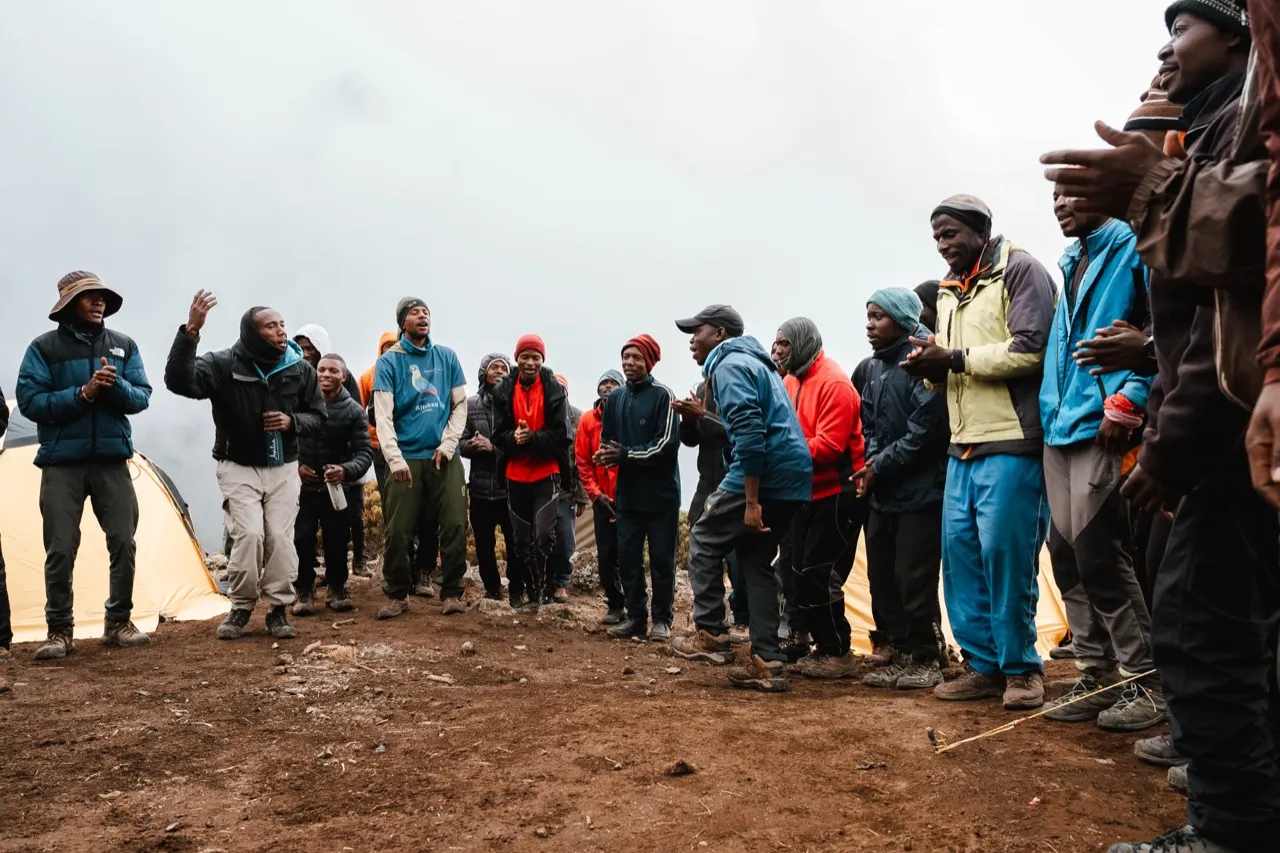
The variable part is where the real differences — and the real risks — live. Kilimanjaro Porters Assistance Project (KPAP), a Tanzanian NGO that monitors porter treatment and certifies operators as “Partner for Responsible Travel” companies, sets a mandated minimum porter wage (TSh 25,000/day, roughly $9.43, since a December 2024 revision) and enforces a maximum 20kg load per porter among its partner operators — but neither of those standards is a government requirement, and non-partner companies aren’t bound by either one. That gap is exactly where a genuinely cheap quote gets cheap: not from an operator working more efficiently, but from an operator paying porters less, loading them more, feeding the crew worse, or skimping on the safety gear — pulse oximeters, bottled oxygen, properly rated tents — that a serious operator carries as standard.
Getting there
Start with what’s non-negotiable. For a standard 7-day camping route, TANAPA’s own tariff works out to roughly $490 in conservation fees (7 days at $70), $300 in camping fees (6 nights at $50), and a flat $20 rescue fee — an $810 subtotal that becomes closer to $950 once Tanzania’s 18% VAT is added. Marangu swaps the camping line for the $60/night hut fee, which nets out to a slightly higher fixed cost despite Marangu often being marketed as the “budget” route on the strength of its shorter itinerary. Every legitimate operator, whatever they charge you, is paying TANAPA this same amount per climber — it’s the one line item you can verify independently of anyone’s marketing.
Everything above that fixed floor is operator margin, and it’s mostly spent — or not — on the crew. TANAPA charges operators a flat TSh 5,000 (about $1.90) per Tanzanian staff member per trip just for park access, which is trivial next to what that same crew member should actually be paid to do the job: KPAP’s mandated minimum for a Partner company is TSh 25,000 (about $9.43) per porter per day, with lead guides, assistant guides, and cooks earning more on top of that under most operators’ own published scales. A realistic crew for a group of a few climbers runs to a guide, an assistant guide or two, a cook, and several porters carrying food, tents, and equipment — multiply even the minimum daily wage across a week and several crew members, and it becomes clear why a bare-minimum-fee climb priced anywhere near $1,200 has almost no room left to pay that crew properly, let alone cover food, transport to the trailhead, gear maintenance, and any operator profit. SafariBookings’ own advisory copy puts its “cheapest, shortest and most basic packages” at “US$1,250 per person for the 4-night, 5-day Marangu Route” — the shortest, cheapest route with the lowest reported summit-success rate of the six — though that’s the site’s own editorial framing rather than a guaranteed floor; live listings on the same marketplace move around that number rather than obeying it strictly. Prices climb from around there through a $2,300–$3,100 mid-range band (Altezza Travel, a KPAP partner, describes “a comfortable and safe 7-day group climb” as costing about $3,000 in 2026) up past $6,700 for private, high-comfort departures.
Tips sit outside all of this, paid directly to crew at the end of the climb rather than folded into the operator’s quote. A commonly cited range — attributed by several operators to KPAP guidance, though KPAP’s own current page deliberately avoids fixed numbers given how unevenly wages are enforced — works out to roughly $20/day for the lead guide, $12/day each for an assistant guide and the cook, and $6/day per porter, totaling somewhere between $175 and $290 per climber depending on trip length. Budgeting for tips at that level, on top of the quoted price, is part of the real cost of a climb — and on a properly run trip, it’s the closest thing to a direct, verifiable payment from you to the people actually carrying your gear up the mountain.
When to go
Kilimanjaro’s conservation fee doesn’t move with the seasons the way several other Tanzanian parks’ fees do — TANAPA’s tariff prices it flat, year-round, with no discounted low-season rate the way Serengeti, Manyara, Tarangire, and Arusha get one. What does move seasonally is operator pricing and availability, driven by demand rather than any change in the government fee. The two dry windows — roughly January through March and June through October — are when demand, and with it typical operator quotes, run highest, especially through the July–August peak; KPAP Partner companies also have a fixed number of trained, fairly paid crew, so the busiest months put more pressure on operators to either turn away business or, for the ones willing to cut corners, stretch a crew across more clients than they should.
The shoulder and rainier months — the long rains of March through May and the short rains of November — see softer demand and, correspondingly, more discounted packages from established operators trying to fill departures. That can be a genuine opportunity to book a reputable, KPAP-partner operator at a better rate than peak season would command, rather than a reason to chase an unusually cheap quote from an unknown company: the park fees and porter-wage standards that make a climb safe don’t get cheaper in the rain, even when an operator’s own margin does.
Tours
- Altezza Travel — Kilimanjaro climbs
KPAP Partner for Responsible Travel member; route-by-route 2026 pricing across all six standard routes
- Nature Discovery — Kilimanjaro climbs
KPAP Partner for Responsible Travel member; Moshi-based operator, 30+ years on the mountain
- SafariBookings — Kilimanjaro climbing tours
Compare quoted prices, routes, and reviews across hundreds of vetted operators in one place
| Item | Price | Note |
|---|---|---|
| TANAPA conservation (park entry) fee, per person per day, age 16+ | $70 | Official Tanzania National Parks tariff (1 Jul 2023–30 Jun 2026 cycle, PDF re-published by TANAPA in Feb 2026 — no later cycle found as of this fetch). Flat year-round; unlike Serengeti, Manyara, Tarangire, and Arusha, Kilimanjaro's conservation fee has no separate low-season rate |
| Camping fee, per person per night (all routes except Marangu) | $50 | Same TANAPA tariff. Kilimanjaro's public-campsite rate is higher than the standard $30/night charged at most other Tanzanian parks |
| Hut fee, per person per night (Marangu route only — Mandara, Horombo, Kibo huts) | $60 | Same TANAPA tariff. The one route priced above the camping rate, in exchange for a bunk instead of a tent |
| Rescue fee, per person per trip | $20 | Same TANAPA tariff, covering Kilimanjaro and Meru. Non-refundable, charged once per trip regardless of length |
| Crew fee (Tanzanian staff), per guide/cook/porter per trip | TSh 5,000 (≈ $1.90) | Same TANAPA tariff — a flat park-access charge the operator pays per local crew member, separate from that crew member's actual wage below |
| KPAP-mandated porter minimum wage, per porter per day | TSh 25,000 (≈ $9.43) | Kilimanjaro Porters Assistance Project, mandatory for its ~60 Partner for Responsible Travel operators since a December 2024 wage revision; average actually paid was TSh 25,140/day as of 2024. A rise to TSh 35,000/day (≈$13.20) was expected from January 2026 'subject to the issuance of an official notice' — we could not confirm that notice had been issued as of this page's last-verified date. One separate, older KPAP page still cites a lower, unrevised TSh 20,000/day figure — a discrepancy on KPAP's own site worth knowing about rather than a number we've resolved for them |
| Budget operator climb (shortest, cheapest legitimate packages) | ≈ $1,250 pp and up | SafariBookings' own advisory guide text (not a live listing), fetched today: 'The cheapest, shortest and most basic packages cost from US$1,250 per person for the 4-night, 5-day Marangu Route.' Treat this as SafariBookings' own editorial guidance, not a hard market floor — the same page's live listings are a moving marketplace of hundreds of operators, and individual listings sit above or below this figure at any given time (a 6-day Machame listing at $1,315 was live on today's fetch, for instance). See 'Why go' below for why pricing meaningfully under this range is a red flag rather than a bargain |
| Mid-range operator climb (7–8 days, established operator) | ≈ $2,300–$3,100 pp | Cross-checked between SafariBookings listings and Altezza Travel's own 2026 route pricing, both fetched today; Altezza's own site states 'a comfortable and safe 7-day group climb costs about $3,000' as of 2026 |
| High-end / luxury operator climb | $6,700+ pp | SafariBookings listings, fetched today — private guiding, smaller groups, higher-comfort camping gear, and more built-in acclimatization days |
FAQ
What does the $70-a-day conservation fee actually pay for, and does it change by season?
It's Tanzania National Parks' (TANAPA) standard entry fee for foreign non-resident climbers 16 and older, published in TANAPA's own tariff document and unchanged for the Kilimanjaro-specific line since at least mid-2023. Unlike Serengeti, Lake Manyara, Tarangire, and Arusha — which all carry a separate, cheaper low-season conservation rate in the same tariff — Kilimanjaro's $70/day applies flat, all year. All TANAPA charges, this one included, are published exclusive of Tanzania's 18% VAT, so the number that actually lands on an invoice runs higher than the headline figure once tax is added.
How much do official park fees alone add up to on a typical week-long climb?
More than most first-time climbers expect. Take a 7-day camping route (Machame, for example): 7 days of conservation fee at $70 is $490, plus 6 nights of camping fee at $50 is $300, plus the one-off $20 rescue fee, for a $810 subtotal in park charges alone — before VAT, before a single dollar goes to a guide, cook, or porter, and before food, transport, or gear. Add Tanzania's 18% VAT and you're past $950 in pure TANAPA fees for one climber on one route, on the low end of what a real climb requires. That arithmetic is the honest starting point for understanding why a genuinely rock-bottom price tag doesn't add up.
Why do two operators quote such different prices for what looks like the same route and itinerary?
Because the park fees above are the one cost every legitimate operator pays identically — the difference between a $1,500 quote and a $3,000 quote for a nominally similar 7-day Machame trip is almost entirely what happens after that fixed floor. Higher-priced, KPAP-partner operators pay porters at or above the mandated TSh 25,000/day minimum, carry enough staff that no one porter exceeds the 20kg weight limit, provide real four-season tents and enough food, and carry safety equipment like pulse oximeters and bottled oxygen. Cited industry write-ups on why cheap Kilimanjaro operators are risky are specific about what disappears at the low end: less-experienced freelance guides with no medical training, worn-out or non-waterproof gear, and — repeatedly flagged as the most serious issue — porters paid below any recommended wage, under-fed, and carrying loads over the safe limit. The itinerary on paper can look identical; what you're actually paying for is everything the price makes possible around it.
Is it true that climbs priced under about $1,200 are dangerous? What specifically goes wrong?
The park-fee arithmetic above is the clearest evidence: roughly $950 of a 7-day camping climb's cost is fixed, non-negotiable TANAPA fees and VAT that every operator pays the same way. A price at or below $1,200 leaves next to nothing to cover a guide, a cook, and several porters' wages for a week, their food, transport to and from the mountain, tents and cooking gear, and any margin at all for the operator — which is mathematically very hard to reconcile with paying porters KPAP's mandated TSh 25,000/day minimum or keeping their loads under the 20kg cap. SafariBookings' own advisory text states that its 'cheapest, shortest and most basic packages cost from US$1,250 per person for the 4-night, 5-day Marangu Route' — the shortest, cheapest route with the lowest reported summit-success rate of the six to begin with — but that's SafariBookings' own editorial framing, not a verified floor; the live listings on the same marketplace fluctuate around that figure (a 6-day Machame listing at $1,315 was live on today's fetch) and shouldn't be read as a guarantee that nothing legitimate ever sits below it. What's much better supported is the arithmetic itself: below roughly the low-$1,000s to $1,200 range, the corners that get cut are consistently porter wages and load limits first, then guide experience, safety equipment, and food quality — not the parts of the trip a client sees on day one, but the parts that determine whether everyone on the mountain, paying client and crew alike, comes down safely.
How much should I tip guides, cooks, and porters?
Kilimanjaro Porters Assistance Project's own current tipping page is candid that it deliberately avoids fixed dollar figures, since wage enforcement varies operator to operator — its guidance is to tip crew directly and follow your operator's own recommendation, especially if they're a KPAP Partner company. Several operators, citing KPAP-derived norms, publish a consistent working range: roughly $20/day for the lead guide, $12/day for an assistant guide, $12/day for the cook, and $6/day per porter, adding up to a commonly cited $175–$290 per climber in total tips depending on trip length. Treat that as a widely used starting range rather than an official rate — and remember tips are separate from, and on top of, the crew's base wages covered in the cost table above.
Last verified:
Sources
- Tanzania National Parks — Tariffs, 1 July 2023–30 June 2026 (official TANAPA fee schedule)
- Kilimanjaro Porters Assistance Project — Our Impact (porter wage revisions, average pay, 20kg weight-limit enforcement)
- Kilimanjaro Porters Assistance Project — Becoming a Partner (Partner-company minimum wage standards)
- Mountain Explorers (KRTO/KPAP) — current Partner for Responsible Travel operator directory
- SafariBookings — Kilimanjaro climbing tours (market pricing across vetted operators)
- Altezza Travel — Climbing Kilimanjaro (2026 route pricing; KPAP Partner operator)
- Ultimate Kilimanjaro — How Much Does It Cost to Climb Kilimanjaro (corners cut by low-budget operators)
- Ultimate Kilimanjaro — Tips & Donations (operator-published tipping guidance, attributed to KPAP)