Kilimanjaro Gear List
Last verified:
Why go
A Kilimanjaro packing list looks, at first glance, like any cold-weather trekking list — jackets, boots, a sleeping bag. What makes it worth its own page is that Kilimanjaro compresses nearly every climate on Earth into one trek: you start in humid rainforest heat, pass through moorland and alpine desert, and finish on a summit night that regularly drops toward −29°C. Gear that’s merely adequate for one of those zones is often wrong for the next one a day later, which is why the operators cited throughout this guide converge so consistently on the same layered system rather than any single “warm enough” item.
The other reason this list deserves real attention rather than a quick Amazon order is that two of its numbers connect directly to facts already established elsewhere on this site. The sleeping bag rating operators recommend and the duffel weight they cap you at aren’t arbitrary — the first is set by how cold camp actually gets, covered on the How Hard Is It guide, and the second is set by KPAP’s 20kg-per-porter load limit, covered on the Climb Cost guide. Getting your gear list right isn’t just about your own comfort; the duffel weight in particular is directly tied to whether the person carrying it is being asked to carry a fair load.
Renting versus buying is the other real decision this page exists to help with, and it’s a more reasonable question than gear-list pages sometimes admit. For a one-time climb, spending several hundred dollars on an expedition-grade sleeping bag and shell jacket you may never use again isn’t obviously the smarter move — and two operators’ own, independently checked pricing below gives a real, current sense of what the alternative actually costs.
Getting there
Build the clothing system from the inside out. The base layer’s job is moving sweat away from your skin, not providing warmth, which is why operator gear lists consistently point to moisture-wicking synthetics or merino wool rather than cotton, which stays wet and gets dangerously cold once you stop moving. On top of that goes a mid layer — a fleece or soft-shell jacket — that does most of the actual insulating work on a normal trekking day and is the piece you’ll add or remove most often as the trail climbs or the sun comes out. The insulating layer, a down or synthetic jacket, mostly stays packed away during the day and comes out at camp and on summit night specifically, when temperatures fall furthest below what the mid layer alone can handle. The shell — a waterproof, windproof jacket and matching pants — is the outermost piece, there for rain, wind, and the cutting cold of the final ascent rather than everyday warmth. Layered this way, you’re never stuck wearing either too much or too little for more than the time it takes to add or shed one piece.
Sleep and feet get their own standard for a reason. Climbing-Kilimanjaro.com’s own guidance is unambiguous that a Kilimanjaro sleeping bag should be “rated to -18C, 0F as a minimum,” a 4-season, mummy-shaped bag rather than the 3-season bags most people already own — camp nights on the upper mountain are genuinely that cold, independent of summit night’s more extreme swing. Footwear gets the same seriousness from every source checked for this guide: waterproof boots with good ankle support, worn-in well before departure, because an untested pair — rented or newly bought — is one of the more common, entirely preventable reasons a climber’s feet fail them partway up. A headlamp with spare batteries and a set of trekking poles round out the essentials; poles in particular are credited by more than one operator with meaningfully reducing the joint strain of the long, repetitive descent.
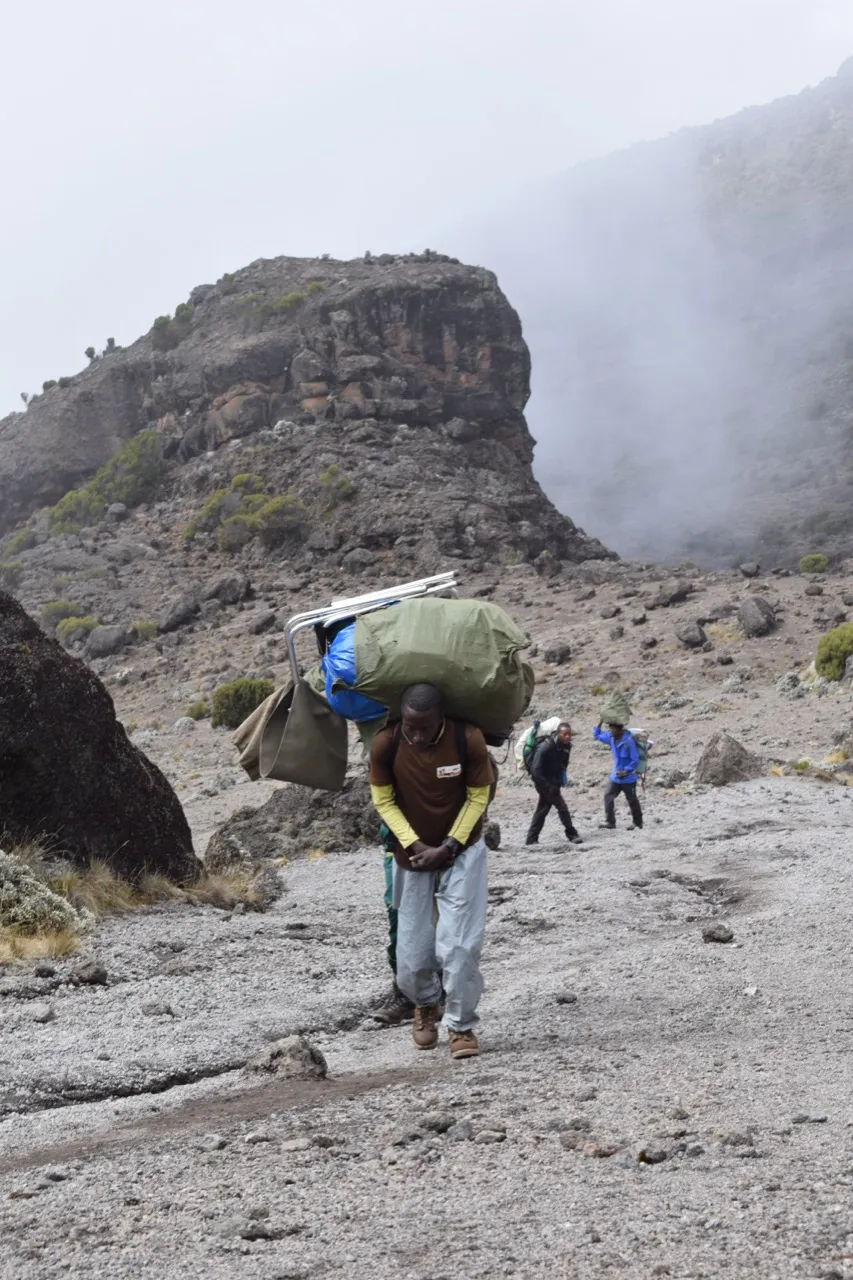
Your duffel bag is where the gear list connects most directly to the rest of this site. Operators commonly cap what you personally pack into it at around 15kg (33–35lb) — noticeably below KPAP’s 20kg-per-porter limit on the Climb Cost guide. KPAP’s own published wording caps a porter at “20kg of company gear” as its own category, without stating exactly how that figure relates to a climber’s duffel specifically; the likeliest read, an inference from how operators set their own lower duffel caps rather than a breakdown KPAP itself publishes, is that the 20kg figure has room in it for a porter’s share of communal food, tent, and cooking gear as well as your bag. Pack lighter than your operator’s cap, not right up to it, and you’re not just making the climb easier on yourself — you’re leaving margin for a responsible operator to keep every porter’s load reasonable, whatever the exact split turns out to be. Water deserves the same practical attention: most guidance calls for 3–4 liters of daily capacity split between a hydration bladder and wide-mouth bottles, with a widely repeated trick — filling a Nalgene with hot water just before bed — doing double duty as a foot-of-the-sleeping-bag warmer and a way to stop it freezing solid overnight.
When to go
Gear doesn’t change by season the way route choice or park fees do — Kilimanjaro’s temperature range is driven far more by altitude and time of day than by which month you climb in, a point the Best Time to Climb guide makes about summit night specifically. What does shift with your booking timeline is the rent-versus-buy decision, and it’s worth making early rather than the week before departure. Renting through your operator in Moshi or Arusha is a real, current option: Altezza Travel’s own 2026 pricing lists a full personal gear-kit rental at $300–350, while Climbing-Kilimanjaro.com’s separate, itemized rental menu — fetched the same day — breaks individual pieces down to $50 for a sleeping bag, $15 each for a rain jacket, rain pants, or trekking poles, and $10 each for boots, gaiters, a headlamp, or a duffel bag. Both figures are real, dated quotes from named operators rather than a single averaged guess, and reserving rental gear in advance is worth doing regardless of which operator you book with, since availability in the right size isn’t guaranteed on arrival.
Boots are the one clear exception to “decide later.” Every source checked for this guide is consistent that rented or unfamiliar boots are a direct route to blisters exactly when you can least afford them, so buying your own boots and breaking them in over the weeks before the climb — not renting them, whatever else you rent — is worth treating as a fixed rule rather than a preference. Everything else on this list can reasonably wait for a rent-or-buy decision made once you know your operator and your budget; your feet can’t.
| Item | Price | Note |
|---|---|---|
| Full personal gear-kit rental (boots, jacket, sleeping bag, poles, etc.) | $300–350 | Altezza Travel's own 2026 figure for renting a complete personal kit rather than buying, fetched today — Altezza is the same KPAP Partner for Responsible Travel operator cited on the Climb Cost guide |
| Sleeping bag rental (4-season, -18°C/0°F class), per climb | $50 | Climbing-Kilimanjaro.com's own published rental price list, fetched today — a separate, itemized quote from the bundled Altezza figure above, given as a real range rather than one number |
| Waterproof jacket, waterproof pants, or trekking pole set rental, each | $15 | Same rental price list — three separate line items happen to share this price point |
| Hiking boots, gaiters, headlamp/torch, or duffel bag rental, each | $10 | Same rental price list — the lower-cost end of the itemized menu, all quoted in USD, cash-only per the operator's own terms |
FAQ
What's the actual layering system I need, and why not just wear a big warm coat?
Because the temperature swing on Kilimanjaro in a single day is enormous — rainforest heat at the gate, freezing wind at Barafu Camp — a fixed heavy coat is either too hot or too cold most of the time. The system operators consistently recommend instead is four separable layers: a moisture-wicking base layer (ideally merino wool, per multiple operator gear lists), a mid layer of fleece or soft-shell for insulation you can add or shed, a down or synthetic insulating jacket for camp and summit night specifically, and a waterproof, windproof hard-shell jacket and pants as the outer layer against rain and wind. You put layers on and take them off as the day and altitude change, rather than living in one garment that's wrong for most of the climb.
How warm does my sleeping bag actually need to be?
Colder-rated than most first-time climbers expect. Climbing-Kilimanjaro.com's own packing guidance is direct on this: "Make sure your Kilimanjaro sleeping bag is rated to -18C, 0F as a minimum," specifying a 4-season, mummy-shaped bag rather than a 3-season model, because a mummy bag's closer fit reduces cold spots and a 3-season bag simply isn't built for the temperatures a high camp sees overnight. That -18°C/0°F class rating is a minimum, not a comfort target — it exists because camp nights well below freezing, not just summit night itself, are a normal part of every standard route.
What's the porter duffel weight limit, and how does it relate to KPAP's 20kg rule?
Operators consistently cap what you personally pack into your porter-carried duffel at around 15kg (33–35lb) — Ultimate Kilimanjaro states "33 lbs (15 kgs)" and Climbing-Kilimanjaro.com states "strictly limited to 15 kg (35 pounds)" — which is deliberately lower than the 20kg-per-porter limit KPAP enforces among its Partner for Responsible Travel operators, covered on the Climb Cost guide. KPAP's own wording caps a porter at "20kg of company gear" as its own line item, and doesn't spell out how that figure relates to a climber's duffel specifically, so treat the connection here as informed inference rather than a rule KPAP states outright: since porters also carry a share of communal food, a portion of the tent, and cooking equipment, operators' own lower duffel caps read as leaving room for that shared load underneath KPAP's 20kg ceiling. Whatever the exact split, packing toward the lower end of your operator's duffel allowance rather than right up to it is the safe practical move — it leaves margin for a responsible operator to keep every porter's load reasonable.
Is it worth buying all this gear, or can I rent it in Tanzania?
For most of the big-ticket, cold-weather items — sleeping bag, insulated jacket, waterproof shell, trekking poles — renting through your operator is a genuinely reasonable option, not just a budget compromise. Altezza Travel's own 2026 pricing puts a full personal gear-kit rental at $300–350, while Climbing-Kilimanjaro.com's separate, itemized rental menu (fetched the same day) prices a sleeping bag at $50, jackets and rain gear at $15 each, and boots, gaiters, and a duffel at $10 each — real, dated figures from two different operators rather than a single source's number. Boots are the one item worth buying and breaking in yourself well before the trip regardless of the rest of your rent-vs-buy decision, since every operator gear list checked for this guide warns that unfamiliar rented boots are a direct route to blisters on summit night.
Does my water freeze on the mountain, and what should I do about it?
Yes, and summit night is by far the worst of it — the How Hard Is It guide's own sourced figures put summit-night temperatures as low as about −29°C. Climbing-Kilimanjaro.com's own packing guidance addresses the overnight version of this problem directly: fill a wide-mouth Nalgene bottle with hot water just before bed, both to warm your sleeping bag and to keep it from freezing solid by morning. Most operators recommend carrying water in a mix of a 2–3L hydration bladder and one or two 1L wide-mouth bottles rather than relying on a bladder alone, and on the summit push specifically, an exposed hydration-tube is the part most likely to freeze first — worth insulating, or leaving the bladder in your pack and drinking from an insulated bottle instead, given how much colder that night runs than anything else on the mountain.
Last verified:
Sources
- Kilimanjaro Porters Assistance Project — Becoming a Partner (20kg-per-porter company-gear weight limit)
- Ultimate Kilimanjaro — Kilimanjaro Gear List (clothing layers, footwear, water capacity, duffel weight limit)
- Climbing Kilimanjaro — Kilimanjaro Packing List (layers, duffel/porter weight limit, water bottle advice)
- Climbing Kilimanjaro — Sleeping on Kilimanjaro (sleeping bag temperature rating)
- Climbing Kilimanjaro — Kilimanjaro Gear Rental (itemized rental price list)
- Altezza Travel — Kilimanjaro Gear (full-kit rental pricing; KPAP Partner for Responsible Travel member)