Kilimanjaro Routes Compared
Last verified:
Why go
Six trails lead to the same summit, and which one you pick changes almost everything about your climb except the final 300 vertical metres. That’s the thing worth understanding before comparing days and dollars: route choice on Kilimanjaro isn’t a cosmetic decision the way it might be on a day hike. It’s the single biggest lever you have over your own odds of standing on Uhuru Peak, because every route’s main variable is really the same one — how many days your body gets to adjust to thinning air before you’re asked to walk through the night to 5,895 metres.
No route up Kilimanjaro requires ropes, crampons, or technical climbing experience; all six are long, high-altitude walks, not mountaineering routes (Mawenzi’s rock faces are the one technical exception on the mountain, and they’re not part of any standard itinerary). That’s exactly why altitude, not terrain, decides who turns back. Operator-reported figures — and there is no getting around the hedge here, because Kilimanjaro National Park does not publish its own summit-success statistics, a gap several operator sites state outright — consistently show the same shape regardless of which company is reporting: routes built around five or six days see meaningfully lower reported success than routes built around eight, nine, or ten. A shorter itinerary isn’t a harder route in the technical sense; it’s a route that gives your body less time to adapt, and altitude does not negotiate with a tight schedule.
That framing is what makes the rest of this page useful. The six routes below differ in scenery, crowding, cost, and whether you sleep in a tent or a hut — real differences worth weighing — but underneath all of that, the days-to-acclimatize count is the number that correlates most consistently with who reaches the top. Choose with that in mind first, and the rest of the comparison becomes a question of budget and taste rather than a guess about your own safety margin.
Getting there
One thing worth flagging before the route-by-route breakdown: the price ranges in the cost table below are wide — sometimes a couple thousand dollars wide on the same route — because Altezza Travel’s own 2026 pricing (checked directly today) prices per person by group size, not a single flat rate. Join or book as part of an 8-plus-person group and you land at the bottom of the range; book solo and you’re at the top. Treat the low end of any range as what a well-filled group departure costs, not as a number you should expect to see on a one- or two-person booking.
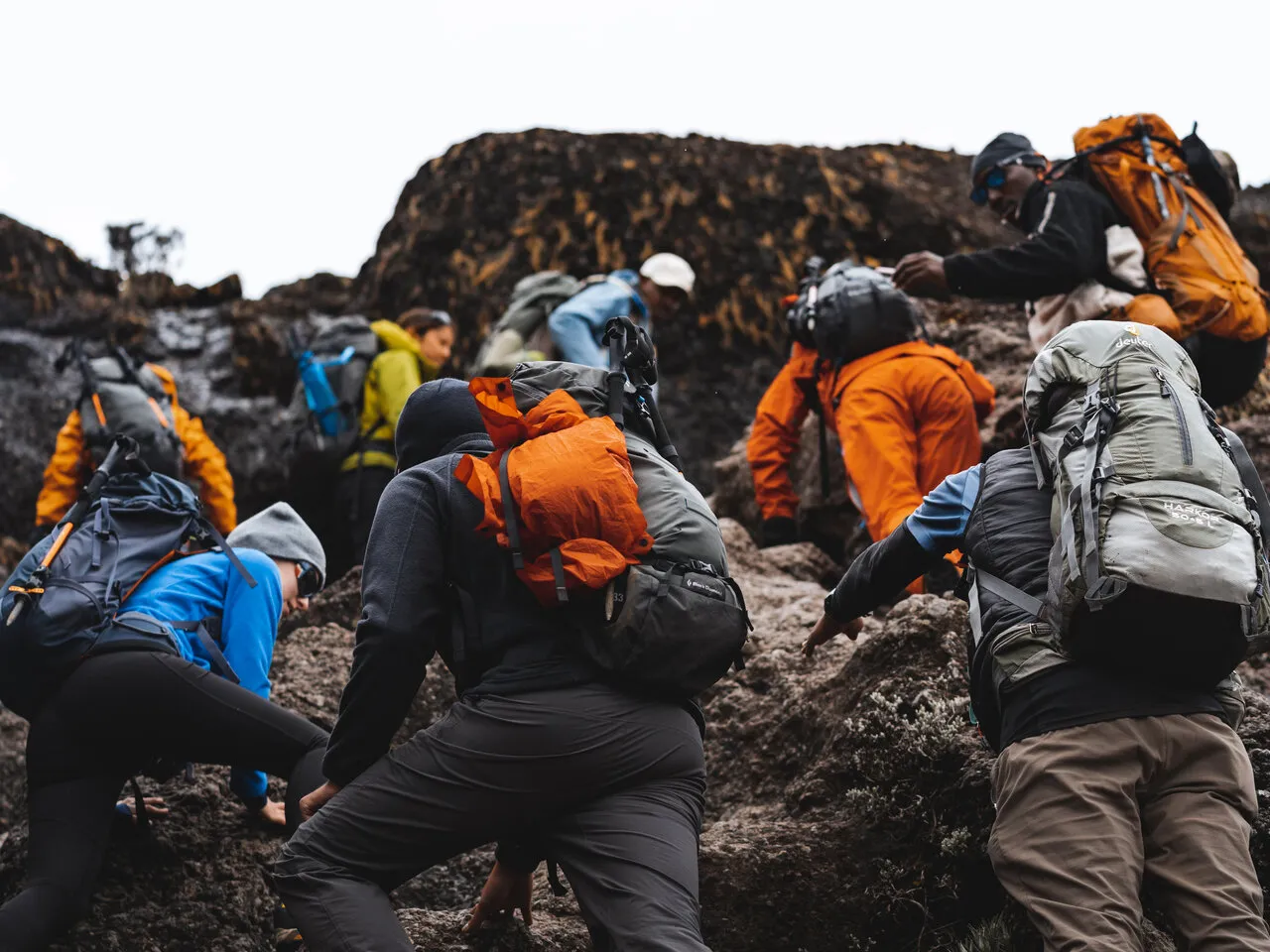
Machame is the mountain’s default pick and its busiest route by a clear margin — 6 to 8 days (7 is the most common itinerary), camping the whole way, and consistently described as offering the most varied scenery of the six as it climbs through Kilimanjaro’s distinct ecological zones. Its popularity is also its main drawback: camps fill up, and you’ll share the trail, especially through the Barranco Wall scramble that Machame and several other southern-circuit routes funnel through together. Operators commonly report success in the low-to-mid 90s percent on the standard 7-day itinerary, dropping noticeably on compressed 6-day versions of the same route.
Marangu is the outlier of the six in two ways: it’s the only route with hut accommodation — dormitory-style huts at Mandara, Horombo, and Kibo, at a published park rate of $60 per person per night against $50 for camping on every other route — and it’s the only route that ascends and descends the same path, which operators consistently cite as the reason it’s rated the least scenically varied. It’s also the shortest standard option at 5 to 6 days and the cheapest to book, and that combination — least time to acclimatize, most crowded huts — is why it’s just as consistently reported as the route with the lowest summit success of the six, especially on its bare 5-day version.
Lemosho and Rongai sit on opposite sides of the mountain and share a similar profile: 6 to 8 days for Lemosho, 6 to 7 for Rongai, both camping-only, both starting quiet before Lemosho merges into the busier southern-circuit crowd partway through. Lemosho approaches over the scenic Shira Plateau with views west toward the Rift Valley and is widely rated among the most beautiful of the six; Rongai, the only route starting from the north near the Kenyan border, trades some of that scenic variety for a genuinely quieter, less-trodden trail through drier terrain. Both are reported in the 85–95% range on their standard itineraries.
Umbwe is the steep, direct outlier — the shortest realistic line up the mountain’s southern side, quiet and remote for its first two days before joining the same busier southern-circuit path Machame uses near Barranco Camp. It’s consistently described by operators as the most physically demanding of the six standard routes; none of the sources checked for this page publish a specific success-rate percentage for it the way they do the other five, which is itself worth noting rather than papering over — treat the absence of a number as a signal to ask your operator directly rather than assume a rate.
Northern Circuit is the newest and longest of the six standard routes — 8 to 10 days, camping, circling the mountain’s quiet northern slopes before joining the summit push from a different angle than any other route. Multiple operators describe it as having both the lowest crowd exposure and the highest reported success rate of the six, which tracks with the acclimatization pattern above: more days built in, better odds reported. It’s also the most expensive of the six to book: Altezza Travel’s own 2026 pricing for the 8-day version runs $3,123–$5,094 per person, before even counting the pricier 10-day crater-camping variant at $4,479–$8,688 — on both, group size moves the per-person price by thousands of dollars, with larger bookings landing at the bottom of that range and solo climbers at the top.
When to go
Route and season interact more than most first-time planners expect. Kilimanjaro’s two dry windows — roughly January through March, and June through October, against the long rains of March–May and the short rains of November — apply to every route, but their effects aren’t identical across all six. Machame and Marangu, the two most heavily booked routes, see their worst crowding precisely during the driest, most popular months (July–August above all), so choosing a quieter route like the Northern Circuit or Rongai during peak dry season is one of the more effective ways to trade a slightly higher price and longer itinerary for a noticeably less crowded trail without gambling on rain.
The reverse trade works too: climbing in a shoulder month like late June, October, or even venturing into the short-rains month of November on a route that’s already quiet — Rongai or the Northern Circuit — compounds the solitude further, at the cost of less certain weather. Marangu’s hut system means it’s the one route where a wet stretch is somewhat more bearable logistically (you’re not pitching a tent in rain), which is part of why some budget-conscious, weather-flexible trekkers accept its lower reported success rate as a tradeoff for that specific comfort. For everyone else, the more reliable move is the one that doesn’t depend on season at all: pick the longest route your schedule and budget allow, because extra acclimatization days improve your odds in July’s crowds exactly as much as they do in November’s quiet.
| Item | Price | Note |
|---|---|---|
| Machame Route — 6–8 days, camping | $2,364–$4,266 pp | Altezza Travel's own Machame route page (KPAP Partner for Responsible Travel member), checked 2026-08-03 by fetching the raw page directly — the full range across its 6- and 7-day departures, from an 8-plus-person group (cheapest per head) to a solo booking (most expensive per head). Altezza's per-person price swings hundreds of dollars with group size alone, so treat this as the real spread, not a single 'from' figure |
| Marangu Route — 5–6 days, huts | $1,956–$3,743 pp | Same method, Marangu's own route page, checked 2026-08-03 — spans its 5- and 6-day departures across the same group-size range. The lowest figure here is the cheapest of all six routes, but see 'Why go' on why cheap and short aren't the same as safe |
| Lemosho Route — 6–8 days, camping | $2,422–$5,116 pp | Same method, Lemosho's own route page, checked 2026-08-03 — spans its 6-, 7-, and 8-day departures across the full group-size range |
| Rongai Route — 6–7 days, camping | $2,442–$4,454 pp | Same method, Rongai's own route page, checked 2026-08-03 |
| Umbwe Route — 6–7 days, camping | $2,387–$4,318 pp | Same method, Umbwe's own route page, checked 2026-08-03 |
| Northern Circuit — 8–10 days, camping | $3,123–$5,094 pp (8-day); crater-camping 10-day variant $4,479–$8,688 pp | Same method, the Northern Circuit route page and its separate Crater Camping variant page, both checked 2026-08-03 |
FAQ
Which route has the best summit success rate?
There is no official, current park-authority statistic to point to — Kilimanjaro National Park does not publish one, a gap several operator sites note explicitly. What exists instead is a pattern that's consistent across operator-reported figures and physiologically sound regardless of source: more days on the mountain means more time to acclimatize, and more time to acclimatize means a meaningfully better chance of standing on Uhuru Peak. Operators commonly report roughly 85–95%+ success on the longer routes — Lemosho, Rongai, and especially the 8–10-day Northern Circuit, which several sites call the route with the best odds — against a figure as low as the high-20s to mid-40s percent on the bare 5–6-day Marangu itinerary. Treat any specific percentage, on this page or anywhere else, as an operator's own reporting rather than a verified park statistic, and treat 'more days' as the one lever you control that reliably moves the odds.
What's the real difference between Marangu's huts and camping on the other five?
Marangu is the only route with dormitory-style huts (Mandara, Horombo, and Kibo) built and maintained inside the park, at a published TANAPA rate of $60 per person per night — versus a $50 per person per night public campsite fee on every other route. The huts mean you're not pitching or striking a tent in the cold, and you get a roof and a bunk, but multiple operator write-ups describe them as cramped and noisy with shared rooms, which is a real tradeoff against the private-tent camping used on Machame, Lemosho, Rongai, Umbwe, and the Northern Circuit. It's also worth knowing that Marangu is the only route that ascends and descends the same path — you see it twice, which is part of why operators consistently describe it as the least scenically varied of the six, alongside its shorter standard itinerary and correspondingly lower reported success rate.
Which route is the quietest?
Machame is described everywhere as the most crowded — it's the most popular route on the mountain and camps fill up accordingly. The Northern Circuit is consistently described as the opposite: it circles the mountain's rarely visited northern slopes and multiple operators cite it as the route with the most solitude, alongside a longer itinerary that gives it the best acclimatization profile of the six. Rongai, approaching from the north near the Kenyan border, and Umbwe, which starts on a steep, quiet line before merging into the busier southern-circuit routes near Barranco Camp, are the next-quietest picks if the Northern Circuit's extra days don't fit your schedule.
Can I just pick a route, or does my operator decide for me?
You choose the route; it's one of the first things a serious operator will ask about, since it drives the itinerary, the price, and — per the pattern above — your realistic odds of summiting. What most trekkers actually optimize for is a mix of budget, time available, and how much they value solitude over convenience: Marangu appeals on cost and hut comfort but carries the lowest reported success rate on its short version; Machame is the default 'good all-rounder' pick precisely because it's popular; Lemosho, Rongai, the Northern Circuit, and Umbwe trade crowd exposure and scenery for varying degrees of extra time and, in Umbwe's case, a steeper and more demanding line. A route mismatched to your fitness, budget, or timeline is a more common reason for turning back than anything about the mountain itself.
Is Umbwe too hard for a first-time high-altitude trekker?
Multiple operators describe Umbwe as the steepest and most physically demanding of the six standard routes — a direct, aggressive line up the mountain's southern flank, quiet and remote on its first two days before merging into the busier southern-circuit route near Barranco Camp. None of the sources for this page publish a specific success-rate percentage for Umbwe the way they do for the other five, but the consistent characterization is that its combination of a short, steep profile and less built-in acclimatization time puts it at the harder end of the six — a route more commonly recommended to trekkers with prior high-altitude experience than as a first Kilimanjaro attempt.
Last verified:
Sources
- Tanzania National Parks — Tariffs, 1 July 2023–30 June 2026 (official fee schedule; Kilimanjaro hut vs. camping fee lines)
- Altezza Travel — Machame Route (2026 per-person pricing by group size; KPAP Partner for Responsible Travel member)
- Altezza Travel — Marangu Route (2026 per-person pricing by group size)
- Altezza Travel — Lemosho Route (2026 per-person pricing by group size)
- Altezza Travel — Rongai Route (2026 per-person pricing by group size)
- Altezza Travel — Umbwe Route (2026 per-person pricing by group size)
- Altezza Travel — Northern Circuit Route, incl. Crater Camping variant (2026 per-person pricing by group size)
- Ultimate Kilimanjaro — Kilimanjaro Routes (day ranges, difficulty, scenery, and traffic by route)
- Climbing Kilimanjaro — Kilimanjaro Success Rate (operator-reported success-rate figures, explicitly flagged as unofficial)